If you’ve ever spent time around metalworking, powder metallurgy, or industrial parts production, you’ve probably seen a hydraulic press—those powerful, thick steel machines that can bend, punch, or compress metal with force that feels almost impossible. But here’s a question I get all the time from new clients, engineering students, and even small-scale startup founders: Can that same reliable, heavy-duty hydraulic press I sell my customers be used for powder compaction? The short answer is yes, but there’s a lot more to it than just shoveling powder into a mold and hitting “go.” As someone who’s been selling hydraulic presses for over a decade, I’ve seen firsthand how well this combination works when you get the details right—and how often people skip critical steps that lead to bad parts or wasted materials. Hydraulic Press

Let’s start with the basics, because that’s where most missteps happen. Powder compaction isn’t just applying force to a pile of dust. It’s a process where loose, fine powder (usually metal, ceramic, or even polymer powder) is compressed into a solid, shapeable “green part” that’s strong enough to handle moving to the next step of production—like sintering, where the part is heated to fuse the powder particles together into a final, finished component. The force here has to be consistent, controlled, and distributed evenly, right down to every particle of powder in the mold. That’s exactly where a hydraulic press shines, because unlike mechanical presses which use fixed rams and can throw off force if the material varies, hydraulics deliver smooth, adjustable force across the full stroke.
I remember a client a few years back, a small aerospace parts maker, who tried to use an old mechanical press he’d picked up used for powder compaction of titanium alloy powder. He came to me frustrated because half his parts were cracking, and the density varied so much he was wasting 30% of the powder he bought. When we walked through his process, it turned out his mechanical press delivered a hard, sudden force that hit the powder in the center of the mold first, leaving the edges loose and causing stress cracks when he tried to remove the green part. A hydraulic press, on the other hand, can apply force gradually, hold that pressure for a set amount of time (we call that “dwell time” in the industry), and release slowly—giving every particle time to settle and bond before the part is ejected. We swapped his mechanical setup for a custom hydraulic press with a dual-ram system for powder compaction, and his waste dropped to less than 5%. That’s the kind of impact the right press makes.
Now, let’s talk about why hydraulic presses are actually the go-to for most powder compaction operations these days, not just a workable alternative. First, force capacity: Powder compaction needs a lot of pressure—sometimes up to 100 tons per square inch, depending on the material. Titanium powder needs higher pressure than aluminum, ceramic powder needs different settings than stainless steel, and a hydraulic press can be sized to match exactly. For small runs, you can get a 10-ton benchtop hydraulic press perfect for lab testing or prototype parts; for high-volume production, we build 500-ton presses that can run 24/7, compacting thousands of parts an hour without dropping force consistency.
Consistency is another big one. In any manufacturing process, consistency is non-negotiable—especially for parts that end up in cars, planes, or medical devices. A hydraulic press has closed-loop control systems now, which means we can program it to apply exactly 200 tons of force, hold for 10 seconds, then move the ram at a precise speed every single cycle. I’ve had clients come to me after using cheaper presses that would vary force by 10 tons from one cycle to the next, leading to parts that were too dense in some spots and not dense enough in others. With a hydraulic press, that variation is less than 1%, which is exactly what aerospace and medical regulators require.
But here’s the part I always warn people about: you can’t just use any hydraulic press for powder compaction. Regular hydraulic presses for sheet metal bending or stamping have different design needs than presses built for powder work. For example, powder compaction almost always uses a die set—two-part metal molds that hold the powder during pressing, often with upper and lower punches that move independently to compress the powder from both sides. A standard hydraulic press has a single ram, so you’d end up with parts that are way denser at the top than the bottom. For that reason, we build hydraulic presses for powder compaction with dual-action or even triple-action systems, where multiple rams move at different speeds and apply pressure from multiple directions. That fixes the density gradient problem I saw with that first aerospace client.
There’s also the matter of die lubrication and powder flow. Powder doesn’t flow like liquid, so it can get stuck in corners of the die or form uneven piles. A hydraulic press’s adjustable stroke lets operators prep the die, vibrate it slightly while filling with powder (some of our presses have built-in vibration controls for that exact purpose), and adjust the punch speed to spread the powder evenly before applying full force. I once worked with a medical device startup that was making small, complex hip implant parts from cobalt-chrome powder. They were having trouble with powder bridging (that’s when powder particles stick together and leave gaps in the part) in the intricate curves of the mold. We modified their hydraulic press to include a programmable slow-fill cycle, where the upper punch moves down just an inch at half speed to gently settle the powder before full compression. That eliminated 90% of the bridging defects they were struggling with.
Another common question I get: Can you use a hydraulic press for cold isostatic pressing (CIP), which is a related process for powder parts? The short answer is yes, though usually with a specialized setup. CIP uses flexible molds and applies pressure evenly from all directions, not just from top and bottom, and hydraulic presses are often used to power the pressure vessels for CIP. We’ve supplied hydraulic systems for small lab CIP units and large industrial CIP lines, because they can handle the high pressure required and maintain that pressure consistently throughout the process.
Now, I’d be lying if I said there aren’t limits. Hydraulic presses aren’t the right choice for every powder compaction job. If you need ultra-high production speeds for very simple parts, a mechanical press might be cheaper upfront, though over time hydraulic presses’ lower maintenance and consistency usually make them more cost-effective. For very small, thin parts that need extreme precision, we pair hydraulic presses with advanced load cells and position sensors to make sure every part is identical—something that’s harder to do with older press technologies.
I also always remind people that powder compaction is a system, not just a machine. The hydraulic press is the core, but you need the right die set, powder handling equipment, and controls to make it work. For example, some powders are reactive—like fine aluminum powder or titanium powder—and need to be compacted in an inert atmosphere. We can integrate our hydraulic presses with vacuum chambers or gas purge systems for those applications, so the whole process stays safe and the powder doesn’t contaminate or react mid-compaction.
Over the years, I’ve watched the powder compaction industry grow a lot, and hydraulic presses have kept up. Ten years ago, most small-scale operations were using manual or semi-automatic hydraulic presses for small runs, but now we have fully automated powder compaction lines that run with minimal operator input, perfect for automotive parts like gears and bearings that millions are made of every year. Those lines use our hydraulic presses because they deliver the consistent, high force needed to meet industry standards like ISO 9001 and AS9100 for aerospace parts.
Let me wrap this up with a real example that stuck with me. A few years back, a team of engineering students from a local university reached out to me to make a small batch of parts for a student rocket they were building. They were trying to make nozzles from copper powder, and their lab press was too weak and inconsistent. We sent them a small benchtop hydraulic press with a custom die set and basic programable controls. They ran 50 test parts, adjusted the dwell time and force based on our recommendations, and ended up with parts that were dense enough to withstand the heat of a small rocket engine. They told me later those parts worked perfectly, and it wouldn’t have been possible with any other type of press.
So to circle back to the original question: Yes, a hydraulic press can absolutely be used for powder compaction—in fact, for most industrial and high-precision applications, it’s the best tool for the job. It’s not a one-size-fits-all solution, but when you pair a properly sized, specialized hydraulic press with the right die, controls, and process knowledge, you get consistent, high-quality green parts that can be sintered or finished into whatever your project needs.
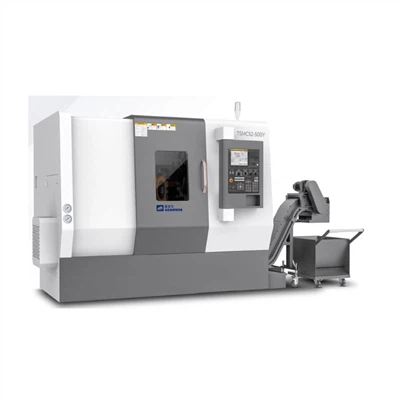
If you’re considering adding a hydraulic press for powder compaction, or you’re having trouble with your current setup, I’m here to help. I’ve worked with everyone from student teams to large aerospace and automotive manufacturers, and I can help you figure out exactly what kind of press and setup will work for your specific material, part design, and production volume. We don’t do one-size-fits-all sales here—we spend time talking through your needs, sharing what we’ve learned from hundreds of clients, and building a solution that makes sense for your business. Whether you need a small benchtop press for prototype work or a full automated line for high-volume production, just reach out to talk through your requirements.
High Speed Press References
- German, R. M. (2014). Powder Metallurgy Science. Metal Powder Industries Federation.
- Klein, A. N., & Deeley, C. W. (2006). Powder Compaction Technology. Marcel Dekker.
- ASTM B212-17, Standard Test Method for Density of Powder Metallurgy (PM) Materials Containing Less Than Two Percent Porosity. American Society for Testing and Materials.
Ningbo Goanwin Machinery Manufacturing Co., Ltd.
Ningbo Goanwin Machinery Manufacturing Co., Ltd. is well-known as one of the leading hydraulic press manufacturers and suppliers in China. Please feel free to buy high quality hydraulic press from our factory. For more information, contact us now.
Address: No.318 Guangming Road, Guangming Industrial Zone, Zhenhai District, Ningbo, China
E-mail: ivy@goanwin.com
WebSite: https://www.goanwin.com/
